


April 8, 2026
When President Donald Trump ordered “Operation Epic Fury” in late February, the American public was promised a geopolitical masterstroke. The rhetoric was as maximalist as the firepower: the U.S. would raze Iran’s missile industry to the ground, annihilate its navy, strip away its nuclear ambitions, and leave the ruling clerics as “toast.”
Six weeks later, as the smoke clears and the ink dries on a fragile, Pakistan-brokered ceasefire, the verdict is in. The United States may have won the tactical air war, but it has suffered a catastrophic strategic defeat. Operation Epic Fury wasn’t a triumph of American hard power. It was an Epic Fail that irrevocably fractured the global order, enriched America’s adversaries, and left a galvanised regime with its hands permanently around the throat of the global economy.
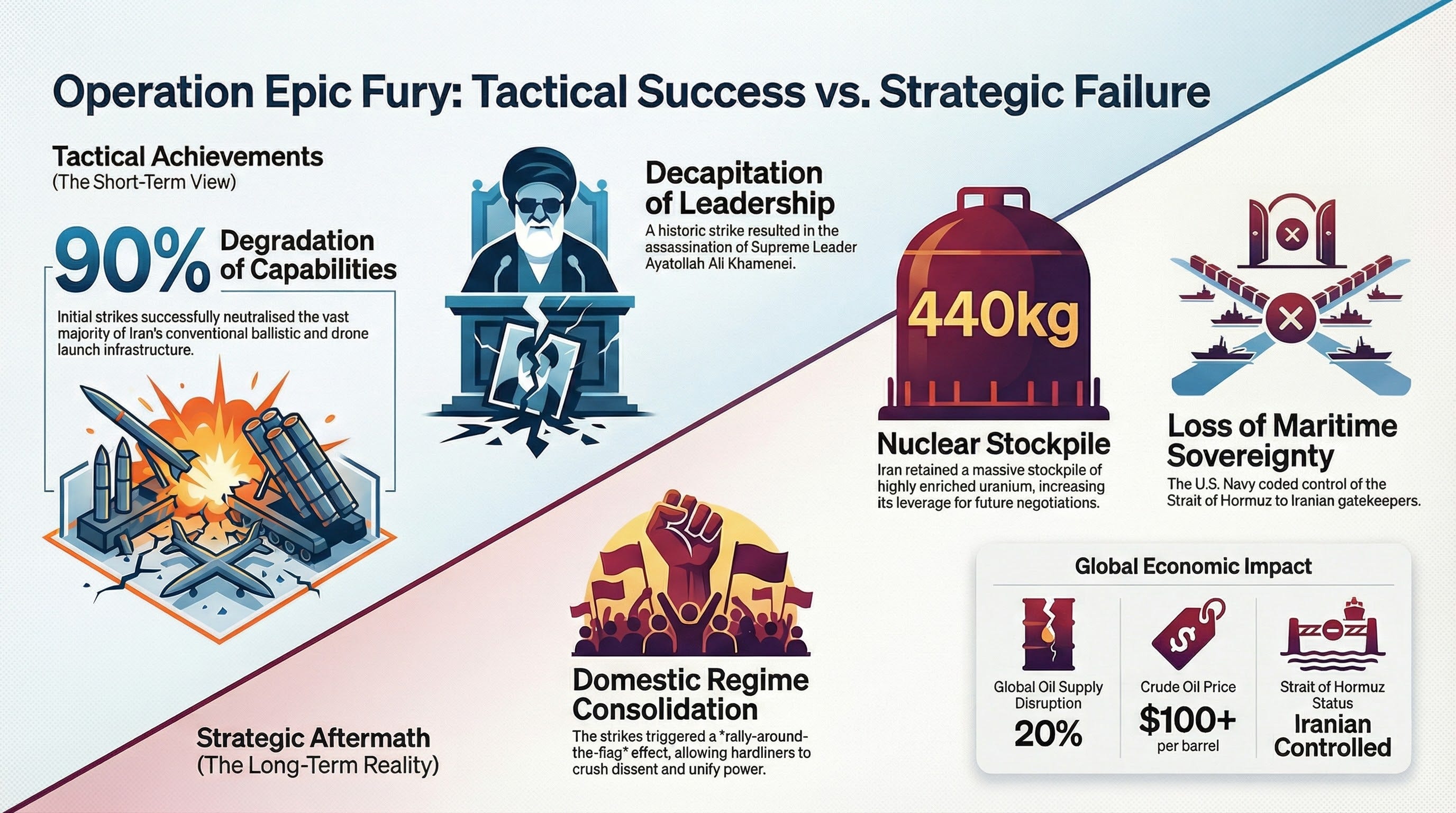
To be sure, the initial shock-and-awe campaign was a display of unrivalled kinetic destruction. U.S. and Israeli stealth bombers cratered Iranian military infrastructure. The assassination of Supreme Leader Ayatollah Ali Khamenei was a decapitation strike of historic proportions. In the opening weeks, Iran’s conventional ballistic and drone launch capabilities were degraded by an estimated 90%.
Cable news cheerleaders took their victory laps. But grand strategy is not measured by flattened bunkers or body counts. It is measured by the political reality left in the aftermath. And the postwar reality is a disaster.
The Regime Change Illusion
The foundational premise of Trump’s February 28 address was that a decapitating strike would collapse the Islamic Republic. Trump explicitly told the Iranian people to “take over your government.”
Instead, the bombs didn’t break the theocracy. They baptized it by fire. The assassination of the old guard triggered a textbook rally-around-the-flag effect, allowing hardliners to seamlessly consolidate power around the new Supreme Leader, Mojtaba Khamenei. Under the banner of wartime survival, the regime unleashed a brutal crackdown on internal dissent — and handed itself the ultimate nationalist cudgel to unify a fractured populace. Far from liberating the Iranian people, Trump’s bombs gave the clerics the gift they had waited decades for: an existential external enemy to point at.
The Nuclear Miscalculation
Here is the inconvenient truth that the post-strike triumphalism refuses to confront: the nuclear threat remains. Iran still retains an estimated 440 kilograms of highly enriched uranium. Tehran has not surrendered it — it is now wielding that near-weapons-grade stockpile as the ultimate bargaining chip, demanding formal recognition of its right to enrich in exchange for lasting peace. Washington dropped thousands of bombs and came away with a stronger Iranian nuclear hand, not a weaker one.
The Economic Own-Goal
Trump promised a “boot-less,” casualty-free war from the air that would secure global stability. But Tehran, realising it could not win a symmetric war against stealth bombers, predictably pivoted to asymmetric warfare — and hit the West where it hurts most.
Using surviving drones and naval mines, Iran successfully choked off the Strait of Hormuz. With 20% of the world’s daily oil supply disrupted, oil rocketed well over $100 a barrel. The American consumer is now bleeding at the pump, paying a punishing domestic tax for a foreign policy miscalculation that was entirely predictable and entirely avoidable.
Worse still, the ceasefire terms represent a humiliating diplomatic concession. The Strait of Hormuz — long championed by the U.S. Navy as a free international waterway — has effectively been handed over to Iranian gatekeepers. Tehran now dictates the terms of “safe passage.” The United States Navy, the most powerful maritime force in human history, spent six weeks fighting to restore access to waters it previously owned by default.
A Windfall for Moscow and Beijing
If you want to know who truly won Operation Epic Fury, look to Moscow and Beijing. For Vladimir Putin, Trump’s war was an economic miracle. The resulting surge in global oil prices entirely rescued the Russian economy, allowing Putin to fund his war machine in Europe with renewed ease. The energy crisis was so acute that Washington was forced to quietly ease sanctions on Russian crude just to keep global markets from outright collapsing. America went to war to weaken its adversaries and ended up writing Moscow a blank cheque.
Meanwhile, Xi Jinping got to watch the United States bog itself down in yet another Middle Eastern quagmire. China watched closely as the West’s fragile defence industrial base was exposed — the U.S. burning through multi-million-dollar interceptors to shoot down $20,000 Iranian drones, depleting critical stockpiles, stretching its Navy to the breaking point. All without China having to fire a single shot. Every missile Washington expended over Iran is a missile not available for the Indo-Pacific. Beijing noticed.
The Death of American Authority
As geopolitical analyst B. Duncan Moench noted in UnHerd, the true, permanent casualty of this war is American authority. The postwar international order was built on a foundation of alliances, shared norms, and the perceived stability of U.S. hegemony.
By launching a unilateral war of choice, making erratic threats to wipe out entire civilisations, and showing reckless disregard for the global economic architecture, the United States shattered the norms that underpinned its global soft power. Terrified European and Gulf allies are now actively hedging their bets. They no longer see Washington as the guarantor of global stability. They see it as the primary disruptor.
Operation Epic Fury was a tactical masterclass wrapped in a strategic suicide vest. The U.S. military successfully levelled Iranian infrastructure, but in the process, Washington managed to save the Russian economy, empower China, fracture its own alliances, hand a more radicalised Iranian regime a permanent chokehold on the global oil market — and leave the nuclear threat entirely intact.


